Next.js vs. React in 2026: Why Enterprise Teams are Migrating to the AI-First Stack
Enterprise migration from React to Next.js in 2026 is mandated by the collapse of link-based ranking in favor of AI-driven citations. While React remains the UI foundation, Next.js architecture is the mandatory delivery vehicle for original, data-rich content required to satisfy the 2026 Information Gain thresholds. This structure ensures content is extractable for AI crawlers, securing brand presence in a landscape where 80% of searches result in zero clicks.
The 2026 Landscape: Why "Ranking" Is No Longer the Goal
In 2026, the primary KPI has shifted from organic traffic to "Answer Presence." With 80% of searches now resulting in zero-click outcomes—where LLMs synthesize answers directly on the results page—visibility depends entirely on being cited as a source.
Furthermore, industry projections indicate that LLM-driven traffic is on track to overtake traditional Google search volume by 2027.
| Dimension | Traditional SEO (Pre-2024) | Generative Engine Optimization (2026) |
|---|---|---|
| Target Output | Rank #1 (List of links) | AI Citation (Synthesized answer) |
| Key Signals | Backlinks and Keyword match | Entity Proof and Information Gain |
| Information Processing | Indexed database retrieval | Real-time synthesized generation |
| Primary Metric | Organic Sessions / CTR | Citation Frequency / Answer Presence |
The Technical Migration: Next.js as the Enterprise Standard
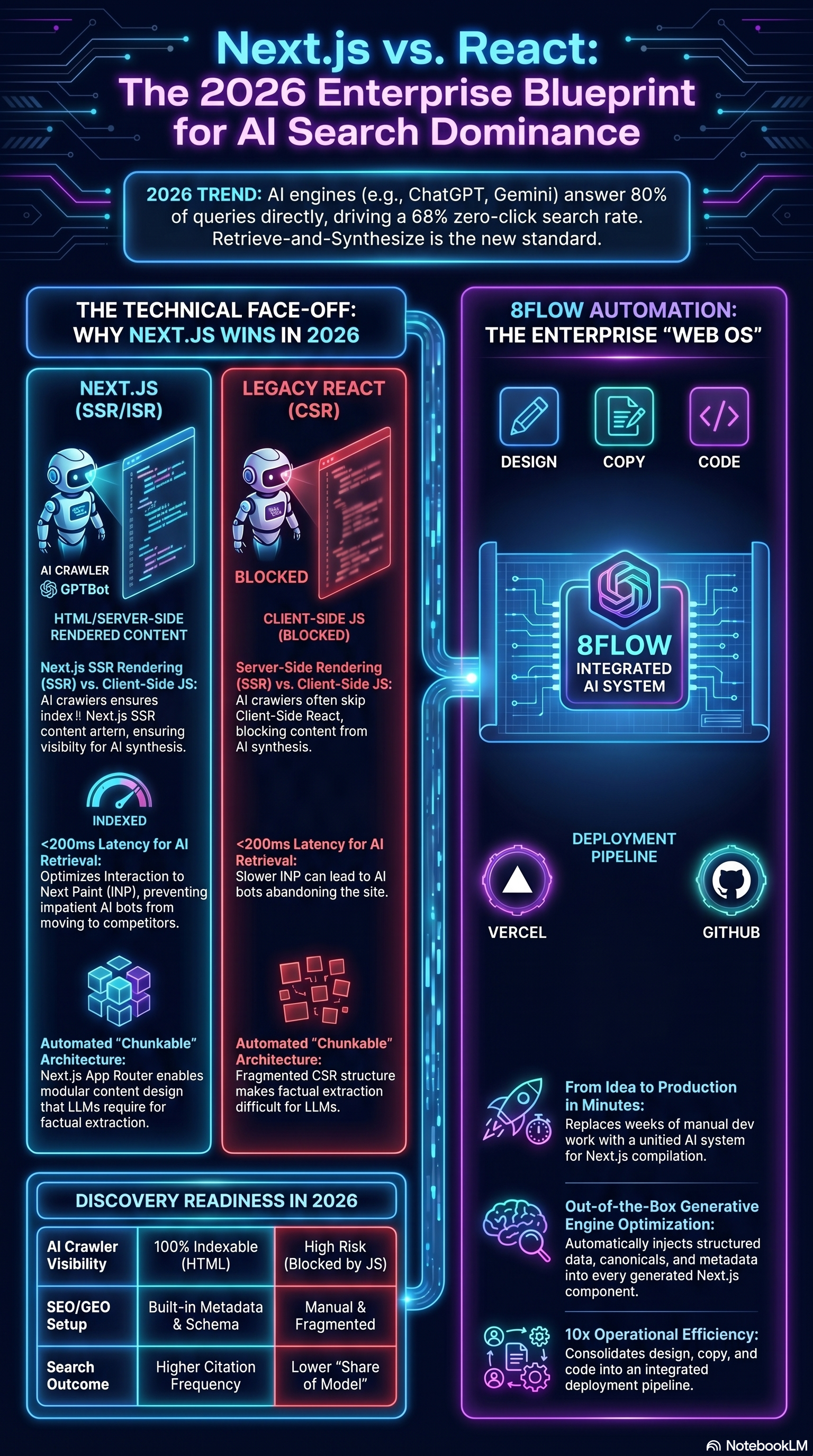
For production-grade environments, standard React Single Page Applications (SPAs) represent significant SEO debt. Modern enterprise teams use Next.js to implement a "Fact-Block Architecture"—modular content structures that are programmatically predictable for AI systems.
- Server-Side Rendering (SSR): Modern AI crawlers, including GPTBot, PerplexityBot, and Brave Search (the primary crawler for the Claude model), prioritize server-rendered content. These bots lack the compute overhead to reliably execute the complex client-side JavaScript of a React SPA, making SSR a non-negotiable requirement for visibility.
- Performance Moats:AI retrieval systems use technical health as a quality proxy. Next.js enables teams to stay below the 1,800ms Time to First Byte (TTFB) "Poor" threshold.
Architect’s Note:In multi-regional AWS environments (specifically ap-southeast-1), TTFB exceeding this threshold is frequently linked to AWS CloudFront misconfigurations, leading to measurable crawl efficiency losses.
Information Gain:The February 2026 "Discover" Core Update explicitly weights "Information Gain"—the measure of new, unique, and verifiable insight—as a primary ranking signal. Next.js allows for the programmatic insertion of Answer Capsules and standalone answer paragraphs that satisfy these algorithmic thresholds.
Optimizing for AI Citations: The "Citable" Content Framework
Earning citations requires content that is structured for machine extraction. To maximize retrieval confidence, we utilize the "Four Traits of AI-Citable Content":
- Statistics: Claims must move from generic statements to verifiable facts. Content containing unique data points sees a 30–40% boost in citation likelihood.
- Source Citations: AI systems verify claims against their own retrieval sets. Heavily cited content in 2026 maintains an entity density of 20.6%, utilizing named, verifiable references over vague descriptions.
- Expert Quotations: Attributing insights to named entities with verifiable credentials increases citation probability.
- Readability (Standalone Answer Architecture): AI models extract "chunks" of 120–180 words. Crucially, 78.4% of citations containing questions come from headings. Therefore, H2 and H3 tags must be phrased as direct questions, with the immediately following paragraph providing a standalone, direct answer.
Upload infographic to:
/public/blog-assets/nextjs-vs-react-enterprise-migration-2026/infographic.png
8Flow Automation: The Fast Path to Next.js Adoption
8Flow Automation functions as an "Enterprise AI Web OS," replacing disjointed dev cycles with a unified system that generates production-ready code rather than prototypes.
The 8Flow Operational Blueprint:
- Semantic Blueprinting: The system audits target niches and performs "Conversion Strategy Mapping" before a single file is rendered.
- Code Compilation: The platform concurrently triggers AI copywriting, UI layout structuring, and responsive Next.js compilation.
- Autonomous Deployment: Code assets are pushed to GitHub and deployed immediately to Vercel, bypassing manual hosting overhead.
Technical Checklist for AI Visibility
- ✓Crawler Access: Explicitly allow AI crawlers (GPTBot, ChatGPT-User, and Brave Search for Claude) in robots.txt.
- ✓Schema Reconciliation: Implement JSON-LD Schema (FAQPage, Article, Person) using sameAs arrays to link to LinkedIn, Crunchbase, and Wikipedia.
- ✓SSR Deployment: Utilize Server-Side Rendering for all high-intent commercial pages to bypass JS-rendering blocks.
- ✓Answer Capsules: Place bolded capsules (40–60 words) within the first 30% of content to satisfy the "ski ramp" distribution of LLM citations.
- ✓Standalone Answer Architecture: Ensure the paragraph immediately following an H2/H3 provides a direct answer to the heading's question.
2026 Enterprise FAQ
Can AI-generated content rank in 2026?
Only if it provides "Information Gain." Purely aggregated AI text lacks the original data or proprietary insights required by the February 2026 Discover core update. Successful content must provide unique survey data or expert opinions that LLMs cannot reproduce from existing training sets.
Why is SSR mandatory for AI search?
Most LLM crawlers do not execute JavaScript efficiently. If your content is rendered client-side, bots frequently see a blank page, excluding your brand from the "Answer Layer."
How does 8Flow Automation handle SEO out-of-the-box?
8Flow automates the technical foundation, including automated metadata injection and structured data generation, ensuring every Next.js asset is production-ready for both Google and AI engines.
Schema Implementation Recommendations
To maximize AI retrieval confidence, implement comprehensive Article and FAQ Schema nodes. Avoid non-standard code blocks and focus on plain-text JSON-LD injection in the document head:
- Organization Node: Define the publisher with a sameAs array linking to canonical profiles (LinkedIn, Crunchbase, and Wikipedia/Wikidata).
- Person Node: Define the author as a discrete entity with verifiable credentials and sameAs links to external professional associations.
- FAQPage Node: Explicitly map H2/H3 questions to their respective Answer Capsules to facilitate direct extraction.
- Entity Reconciliation: Use the sameAs property to link author and organization entities to external hubs to prove "Digital Fingerprint" consistency.
Ready to migrate your enterprise to Next.js?
Deploy a production-ready Web OS with 8Flow Automation.
Get Started Free